
Understanding Edentulism
Edentulism refers to the condition of missing teeth. It can be:
- Complete edentulism – all teeth are missing in one or both arches.
- Partial edentulism – some natural teeth are still present in the arch.
Dental professionals use different replacement options depending on the condition, ranging from dentures to dental implants.
What Are Dental Implants?
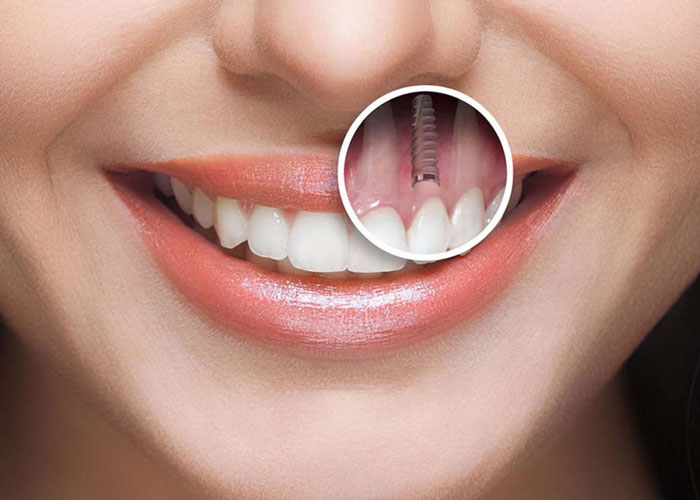
Dental implants are a permanent tooth replacement option. A titanium post is surgically placed into the alveolar (jaw) bone to support one or more teeth.
The process typically involves:
- Placement of implant – the titanium post is inserted into the jawbone.
- Healing period – bone fuses with the implant (osseointegration).
- Abutment placement – a connector piece is added.
- Crown or prosthesis – a natural-looking restoration is fixed on top.
Implants function like natural teeth and are designed to last for decades with proper care.
What Are Dentures?
Dentures are prosthetic replacements for missing teeth. They may be removable or fixed:
- Partial Dentures
- Removable:
- Acrylic partial dentures – made of acrylic with clasps.
- Cast partial dentures – made using lost wax casting, available as clasp-retained or attachment-retained.
- Fixed: Fixed partial dentures (bridges) are supported by adjacent teeth (abutments). The false tooth is called a pontic.
- Removable:
- Complete Dentures
- Used when all teeth are missing.
- Rely on mucosal surface and alveolar ridges for support.
- Can be traditional removable dentures or implant-supported overdentures.
Advantages of Dental Implants Over Dentures
✅ Longevity
- Implants can last 20–30 years or more with proper hygiene.
- Dentures usually need replacement every 10 years.
✅ Preservation of Natural Teeth
- Partial dentures put extra stress on healthy adjacent teeth.
- Fixed dentures require filing down healthy teeth to place retainers.
- Implants are independent and do not affect surrounding teeth.
✅ Prevention of Bone Loss
- When a tooth is lost, the bone begins to resorb (shrink).
- Implants stimulate the jawbone like natural teeth, preventing bone loss.
- Dentures rest on gum tissue without bone stimulation, leading to bone deterioration over time.
✅ Better Oral Health
- Acrylic partial dentures (“flippers” or “gum strippers”) can cause gingival recession with long-term use.
- Implants mimic natural teeth and, with proper oral hygiene, do not cause gum recession.
✅ Easy Maintenance
- Dentures require frequent cleaning, soaking, and adhesive use.
- Implants need only regular brushing, flossing, and mouth rinsing—just like natural teeth.
✅ Improved Comfort & Confidence
- Complete dentures may slip while eating or speaking.
- Implant-supported dentures (removable or fixed) stay firmly anchored, providing better chewing ability, clearer speech, and more confidence.
✅ No Frequent Adjustments
- Traditional dentures may need relining or rebasing as the jawbone changes.
- Implants prevent bone loss, reducing the need for such procedures.
Advantages of Dentures Over Implants
- Cost – Dentures are more affordable than implants.
- Non-invasive – Dentures do not require surgery, making them suitable for patients who want a less invasive treatment.
- Medical limitations – Patients with uncontrolled systemic conditions (e.g., uncontrolled diabetes) may not be good candidates for implants, as healing complications such as peri-implantitis can occur.
Final Thoughts
When considering long-term benefits:
- Dental implants are the superior option for healthy individuals who can maintain good oral hygiene. They preserve bone, protect natural teeth, and provide durability and comfort.
- Dentures may still be suitable for patients seeking a more affordable or non-invasive treatment option.
With the right oral hygiene and care, implants can give you a lifetime of confident smiles.